The IP Race Is Accelerating Faster Than the Workforce Built to Run It

There is an old line about planting trees: the best time was years ago, the second best time is now. It applies awkwardly well to how companies are integrating AI into intellectual property management. Two years ago would have been the ideal moment to start. This year is the realistic one, and the numbers below explain why waiting further gets expensive.
The first two pieces in this series looked at why protection has to move as fast as innovation, and at the sequential, specialist-gated process that currently keeps it from doing so. This piece looks at the scale of what is moving through that process. Global filing volumes are growing far faster than the specialist workforce trained to handle them, and the fastest-growing technical fields are also the ones with the least settled prior art. That combination is what actually creates the opportunity, and the risk, for incumbents and new entrants alike.
Filing Volumes Have Doubled in a Decade
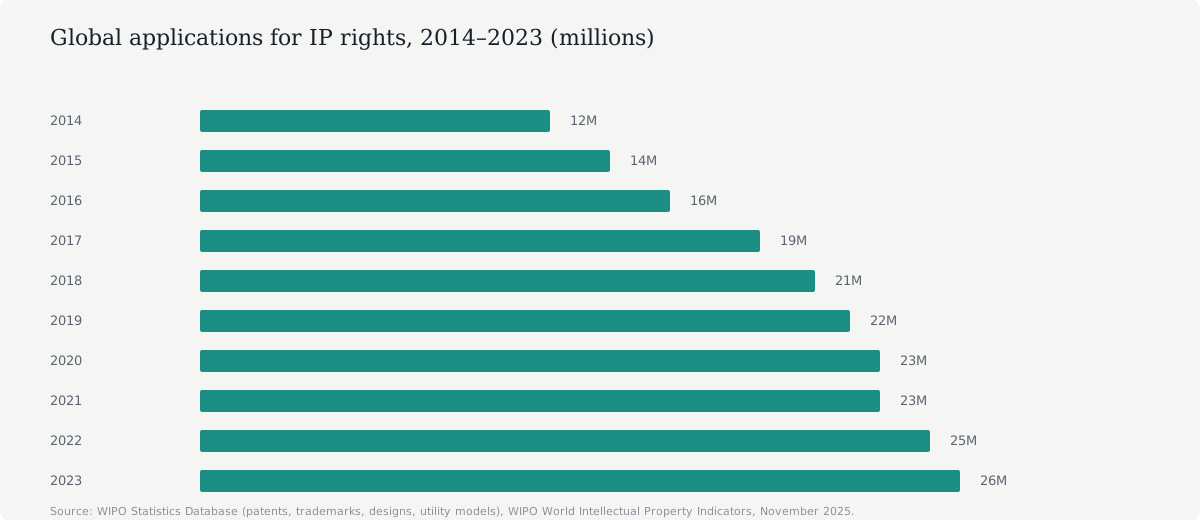
Worldwide IP applications have more than doubled in ten years, and 2024 was the fifth consecutive record year for patent filings alone. The number of qualified patent attorneys, examiners, and technical specialists has not grown anywhere close to that rate. The pressure this creates is not really about total demand for protection. It is about throughput, how many applications a fixed pool of specialist labor can move through a six-stage sequential process before the queue itself becomes the limiting factor.
IP-Intensive Industries Now Anchor the Economy
These are not niche figures. IP protection sits underneath close to half of economic output and employment in the world's two largest economic blocs, and workers in IP-intensive sectors are paid meaningfully more than the rest of the workforce. Treating IP filing as a slow, manual afterthought means treating a large share of the modern economy that way.
R&D Spending Is the Fuel Behind the Filings

The United States and China together account for the largest share of an estimated $3.8 trillion in global R&D spending, with the European Union and the rest of the OECD close behind. Almost three-quarters of that spending inside the OECD comes from businesses rather than governments or universities, which means it is spending done by organizations that need a commercial return on what they invent. Software and computer-services R&D grew faster than any other sector in 2025, largely on the back of AI investment, which points directly at where the next wave of filings is coming from.
The Patent Race Is Accelerating and Shifting East
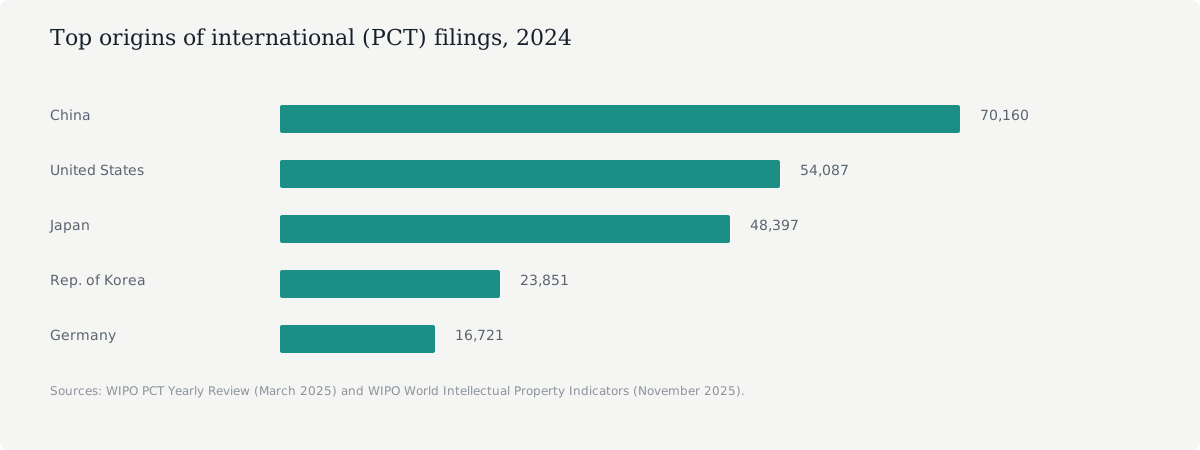
Asia now files roughly 70 percent of the world's IP. China alone filed 1.8 million patent applications in 2024, nearly half the global total, with 93 percent of those filed domestically rather than internationally. Computer and information technology is the single largest field in published patents at 13.2 percent, ahead of electrical machinery and digital communication. India's filings grew 15.7 percent in 2023, its fifth consecutive year of double-digit growth.
The fastest-growing filing categories sit in newer technical territory: artificial intelligence, robotics, smart industrial systems, cyber-physical systems, autonomous systems. These fields do not have decades of settled prior art and established claim conventions behind them the way mechanical or chemical patents do. That absence of a well-worn path is exactly what creates room for new entrants to establish a defensible position before the field settles around a smaller set of incumbents.
Where Speed Meets Judgment
This is not an argument for filing faster purely for its own sake. A patent attorney with twenty years of experience in mechanical or pharmaceutical patents can still struggle to properly scope a claim in a fast-moving software or robotics domain, not for lack of skill, but because the relevant prior art and claim conventions in that domain are still being written in real time, sometimes weeks before a given filing. Emerging fields need both the search speed to track a fast-moving prior art landscape and the seasoned judgment to know what actually deserves protection within it.
AIIPO approaches that gap by pairing continuously updated, AI-driven prior art search and drafting, the same parallel execution model described earlier in this series, with review from qualified IP counsel, instead of asking either side to cover the whole problem alone. Filing volume is growing faster than the specialist pipeline that once kept pace with it. Based on the numbers above, closing that gap is not a future problem. It is already several years overdue.
Published by AIIPO, an AI-supported intellectual property orchestrator built by EneIT Solutions LLC.